
Every US payer engineering roadmap right now has January 1, 2027 circled in red. That is the CMS-0057-F Prior Authorization API enforcement date, and the natural instinct is to solve it with the shortest possible path. The trouble is what happens the very next morning, when a stack that was scoped narrowly to one rule meets the next four regulations already in flight.
If you want to see how this same pressure has been playing out on the provider side, the US healthcare interoperability hub tracks the same broader story: FHIR is stopping being a project and starting to be the substrate.
What CMS-0057-F Actually Requires by January 1, 2027
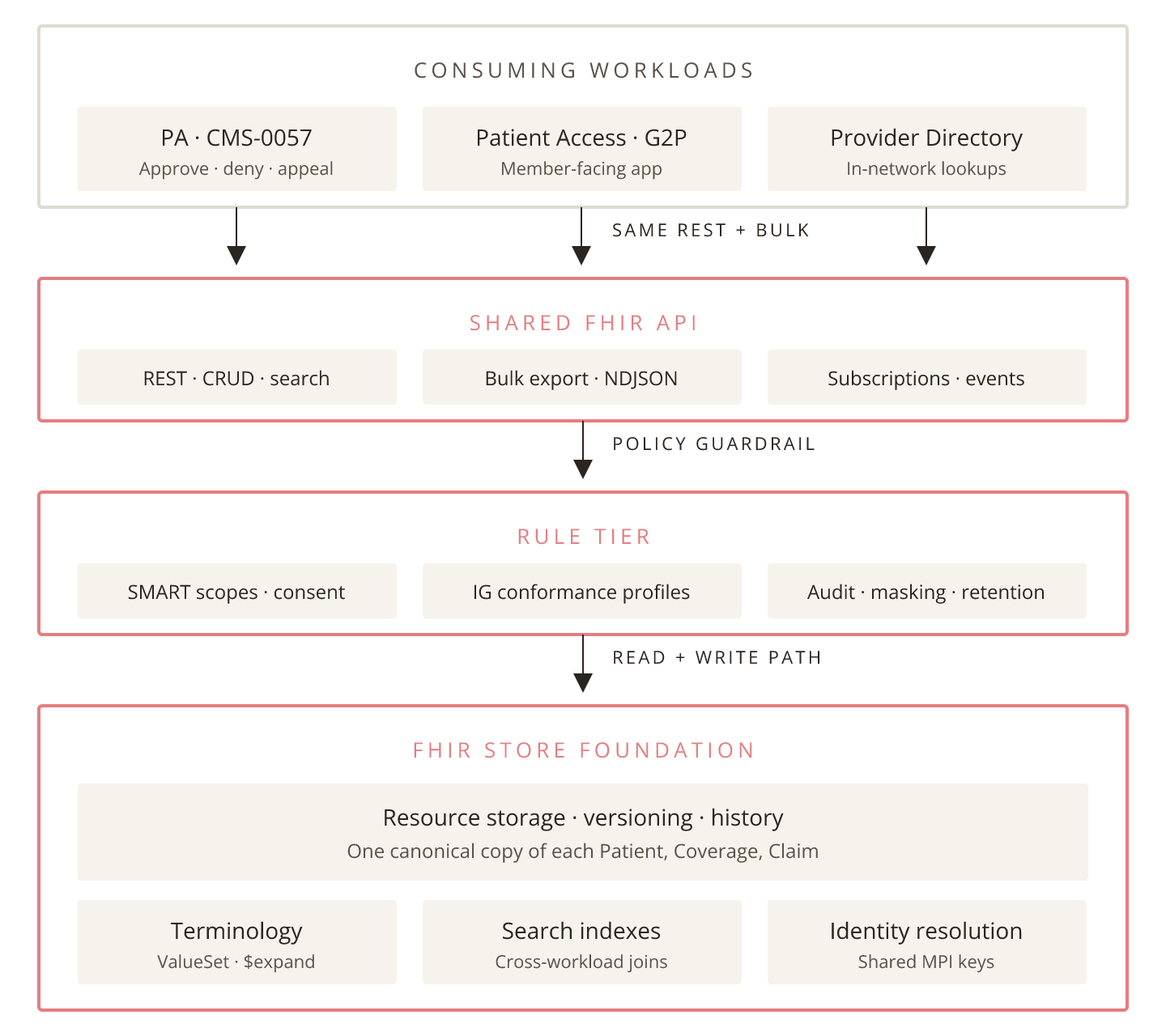
The Interoperability and Prior Authorization Final Rule, published by CMS in early 2024, obliges impacted payers (Medicare Advantage, Medicaid, CHIP managed care, QHPs on FFEs) to stand up four production FHIR APIs. Those are Patient Access, Provider Access, Payer-to-Payer, and the new Prior Authorization API. Each one lines up with a Da Vinci implementation guide: PDex, PDex Plan-Net, PDex Payer Network, PDex Formulary, CRD, DTR, and PAS.
Payers also owe metrics reporting, quarterly on the PA side, with volume, decision-time percentiles, denial rates, and average turn-around. Those numbers pull from claims, UM, and enrollment systems, but they surface as FHIR resources. That last detail matters more than it looks.
The Rules Already Queued Behind It
Regulators do not stop at one final rule. The horizon that a payer platform has to cover through 2030 is already visible:
- ACA-1156 style network-adequacy reporting, which extends the provider directory dataset beyond what PDex Plan-Net covers today.
- TEFCA participation, which pulls payers into QHIN-mediated exchange for treatment, payment, and operations.
- The Provider Directory refresh work under CMS-4208-F2 and successor NPRMs, which will tighten data-freshness expectations.
- Payer-to-Payer expansion, extending the current 5-year lookback into more resource types and more transitions.
- Continued USCDI cadence: v4 in the current wave, v5 already in the ONC pipeline, both driving new element sets into US Core profiles.
- A likely future ONC certification path for payer FHIR systems that mirrors what providers already live with.
Any platform bought to hit January 1, 2027 in isolation will meet three or four of these within 18 months of go-live.
Why the Point Solution Becomes Legacy on January 2
A CMS-0057-F point service is generally scoped to the four APIs and the PA metrics report. In practice that means a purpose-built FHIR facade wired to your claims and UM engines, with just enough Da Vinci IG coverage to pass a HL7 FHIR IG test tool run. It is fast to buy and fast to install. It is also brittle.
The moment TEFCA or a Provider Directory refresh lands, the payer has to either extend that facade (which was not designed as a reusable store) or stand up a second FHIR platform beside it. Two FHIR platforms means two identity fabrics, two audit trails, two terminology stacks, two SMART on FHIR configurations, and two engineering teams that hate each other by month six.
The Reusable FHIR Store Path
The alternative is to treat CMS-0057-F as the first workload on a reusable FHIR core that will host the next five years of rules. That means a persistent FHIR server that owns Patient, Coverage, ExplanationOfBenefit, Claim, PractitionerRole, and the rest as first-class storage, plus a compliance layer on top that packages the specific API obligations.
For payers already running Aidbox as their FHIR store, Payerbox packages the CMS-0057-F obligations as configurable modules on top, which sidesteps the second-platform decision entirely. The same store then absorbs TEFCA, USCDI v4 and v5, and the Provider Directory refresh without a rebuild.
If you are still evaluating the substrate itself, our 2026 buyer's guide to FHIR servers for US health systems walks through the criteria, and the HAPI vs Aidbox vs Medplum breakdown covers the three architectures American teams shortlist most often.
Which Team This Framing Fits
If your only mandate is to hit one rule and hand the platform to a different team afterwards, a point service is fine. If your team owns payer interoperability for the next five years, buy the store first and add the compliance layer on top. The self-hosted vs managed FHIR server tradeoffs apply the same way on the payer side. January 2, 2027 is the day you find out which decision you made.
Sources
- CMS Interoperability and Prior Authorization Final Rule (CMS-0057-F) — full regulatory text defining the four FHIR APIs (Patient Access, Provider Access, Payer-to-Payer, Prior Authorization), Da Vinci IG references, PA metrics reporting, and January 1, 2027 compliance date for impacted payers
- CMS newsroom fact sheet on CMS-0057-F summarising impacted payers (MA, Medicaid/CHIP FFS + managed care, QHPs on FFEs), API obligations, and compliance timeline — canonical government summary of what a point solution must cover
- CMS 2026 Interoperability Standards and Prior Authorization for Drugs Proposed Rule (CMS-0062-P) fact sheet — direct evidence of the next regulation queued behind CMS-0057-F (drug PA API by Oct 1, 2027; current standards expire Jan 1, 2028), the exact "next rule" that makes a scoped point service legacy
Related Posts