
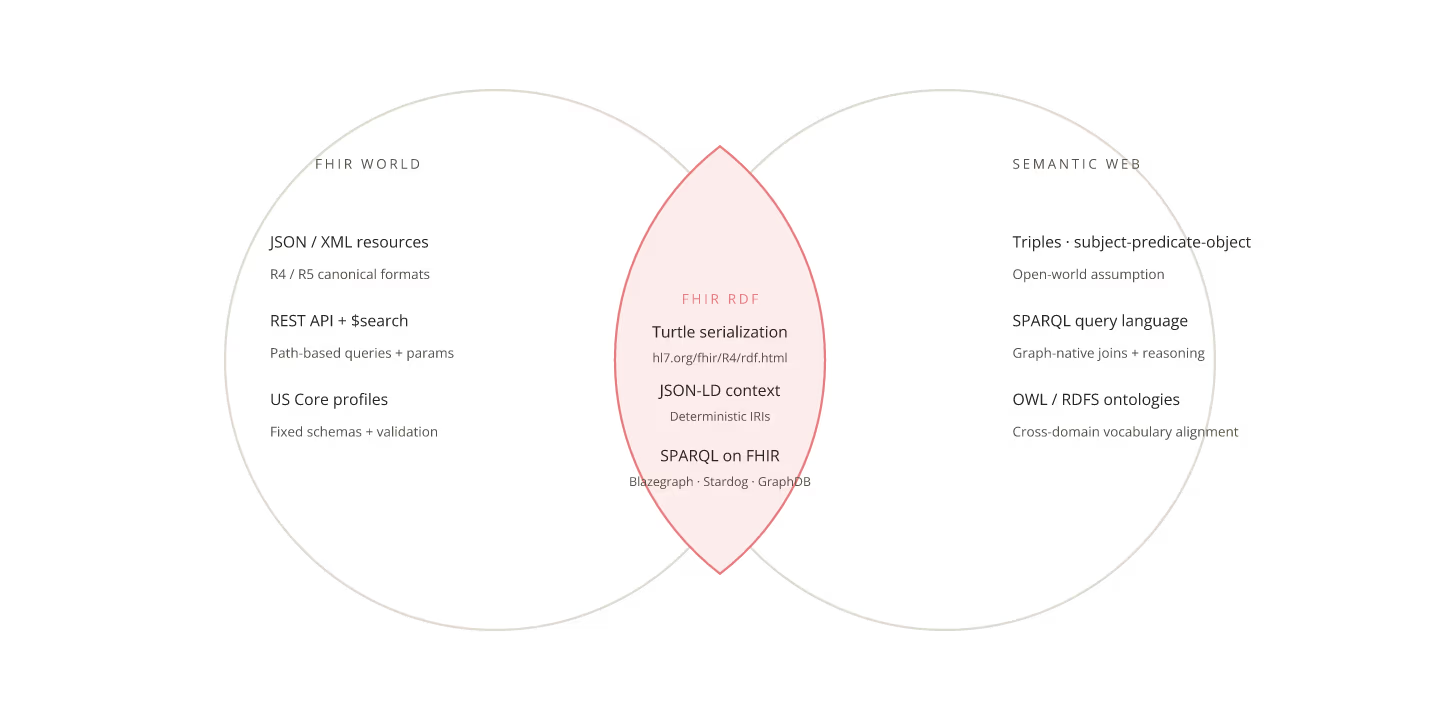
FHIR RDF provides a Semantic Web representation of FHIR resources, opening healthcare data to SPARQL-based queries and reasoning. It's not mainstream in 2026 but has real use cases in research and multi-source data integration.
Where FHIR RDF shines
1. Research data federation. Multiple study sites contribute FHIR resources; RDF representation enables federated SPARQL queries across sites without moving data.
2. Clinical decision support with reasoning. RDF-native reasoners (OWL, SWRL) can infer relationships from FHIR resources plus ontologies (SNOMED CT, LOINC as RDF).
3. Data integration with non-FHIR sources. RDF is the lingua franca for combining FHIR with genomic databases, drug repositories, and public health data.
Where it doesn't
1. Point-of-care clinical workflows. RDF query performance and SPARQL complexity don't fit real-time clinical use. 2. Standard analytics pipelines. Bulk export to NDJSON + warehouse is simpler and more performant. 3. US Core-conformant applications. FHIR REST + JSON is the mainstream path.
Tooling landscape (mid-2026)
| Tool | Purpose |
|---|---|
| Apache Jena | RDF store + SPARQL endpoint |
| Blazegraph | Graph database, RDF support |
| MITRE FHIR RDF converter | FHIR JSON to RDF transformation |
| Ontop | SPARQL over relational (map FHIR SQL to RDF) |
Concrete integration pattern
1. Export FHIR resources via `$export`. 2. Transform NDJSON to RDF via MITRE converter. 3. Load into Jena or Blazegraph. 4. Combine with SNOMED, LOINC RDF distributions. 5. Run SPARQL queries.
FHIR RDF is real technology for specific use cases (research, semantic integration) but isn't the mainstream path in 2026. Pick it deliberately when the use case fits.
Related Posts