
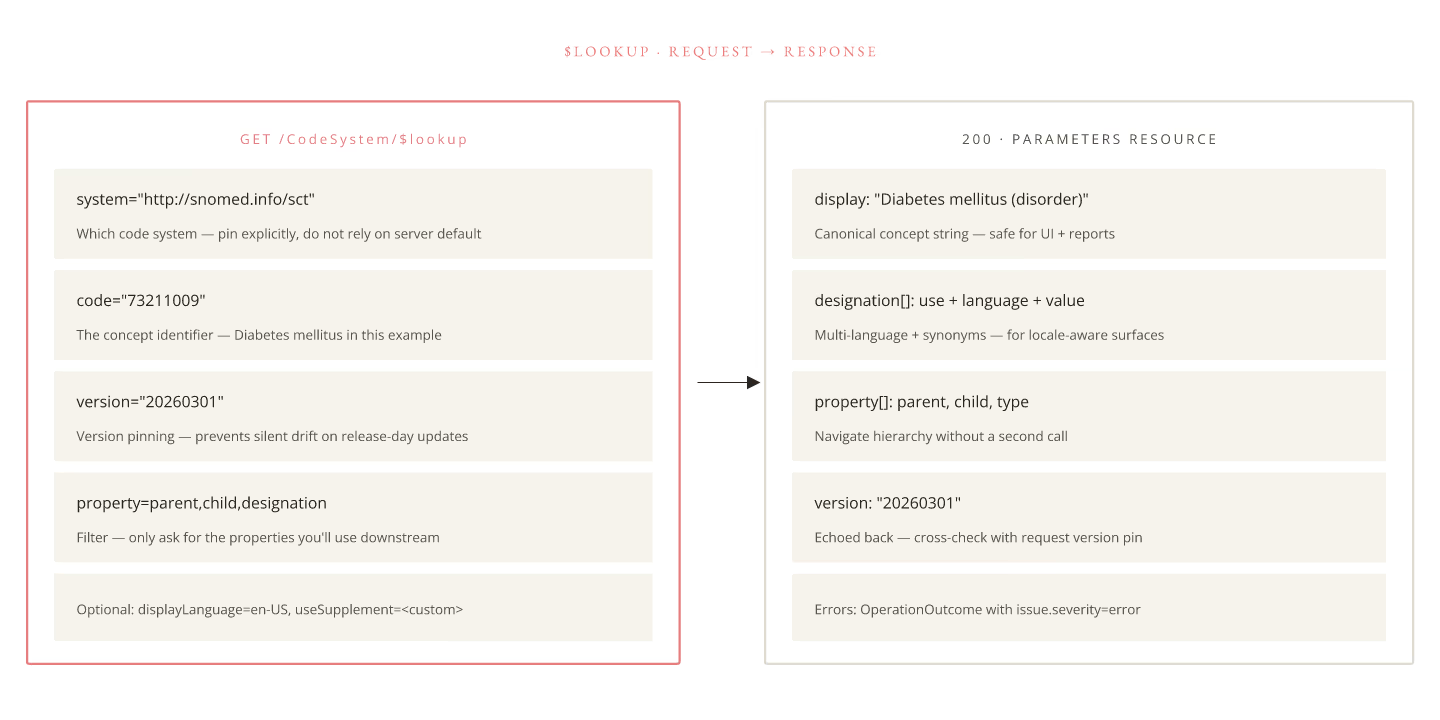
The FHIR `$lookup` operation returns metadata about a coded value — display name, definition, properties, designations. Four patterns cover most production use cases.
Pattern 1: Display name resolution on read. When a client reads a Coding element (e.g., Observation.code), the code is present but display might be stale or missing. Client calls $lookup to get authoritative display. Best for user-facing rendering.
Pattern 2: Property fetching for reasoning. SNOMED CT concepts have properties (ismap, hierarchy). $lookup?property=parent,definition returns them. Best for clinical decision support that needs to reason about codes.
Pattern 3: Multi-language designation. Concepts have translated designations (English, Spanish, French). $lookup?displayLanguage=es returns Spanish. Best for multi-language patient-facing displays.
Pattern 4: Batch lookup via Bundle. For high-volume rendering, bundle multiple $lookup operations into one HTTP call. Reduces round-trip overhead.
Performance considerations
$lookup on individual codes is fast (typically <20ms). Batch lookups for hundreds of codes per view should cache aggressively — most codes are stable across sessions.
Caching strategy
| Data | Cache TTL |
|---|---|
| SNOMED CT displays | 1 month |
| LOINC displays | 1 month |
| RxNorm displays | 1 week (product changes) |
| Local code displays | 1 day (may change) |
Where $lookup breaks
1. Missing code system version. Terminology server without pinned version returns latest, may differ from what was written. 2. Multi-server terminology fragmentation. Different servers with different loaded versions produce different lookups. 3. RxNorm licensing. UMLS license gates access; expired licenses cause 401.
Vendor state (mid-2026)
| Server | $lookup speed |
Batch support | Multi-language |
|---|---|---|---|
| Ontoserver | <10ms | Yes | Yes |
| HAPI terminology | <20ms | Yes | Yes |
| Aidbox terminology | <15ms | Yes | Yes |
$lookup is one of the most under-used terminology operations. Wire it into rendering pipelines rather than embedding display strings in application code.
Related Posts